
Can I Keep My Child Away from the Other Parent in Texas?

Direct Answer/TLDR
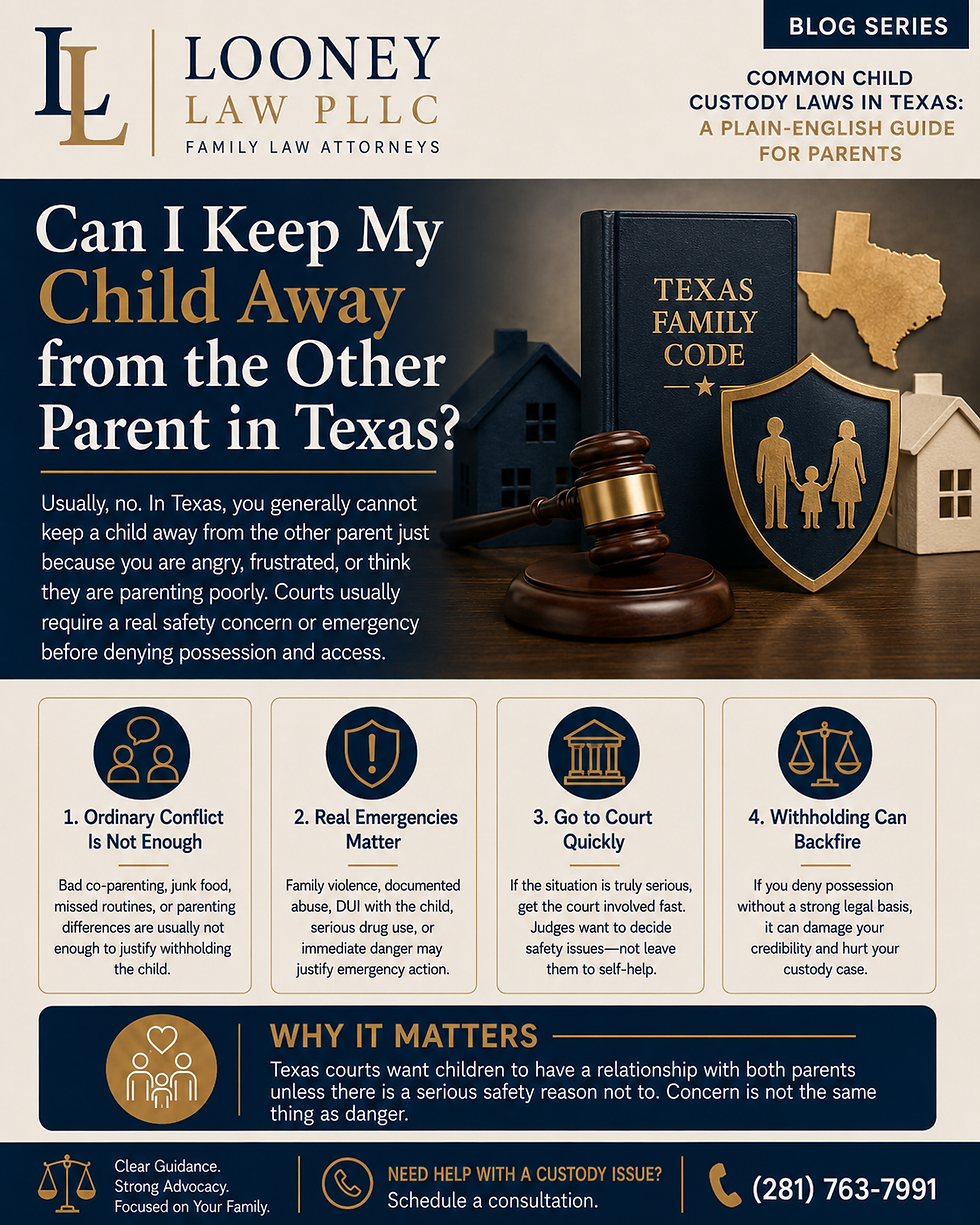
Usually, no. If there is a court order giving the other parent possession and access, you should be very careful about withholding the child unless there is a true emergency.
Parents often believe the other parent is making bad choices. The court may agree that the choices are not ideal and still expect the order to be followed.
The line between bad parenting and dangerous parenting matters. Texas courts are not usually looking for perfect parenting. They are looking for whether the child is safe and whether the order should be enforced or modified.
Bad Parenting Is Not Always an Emergency
I often tell clients that the court’s standard for bad parenting is very different from what a parent may feel emotionally. Judges are not looking for perfect parenting. They may not even be looking for great parenting. A lot of the time, the question is closer to: is the child generally safe?
Parents complain about junk food, too much screen time, late bedtimes, messy houses, poor homework routines, or parenting styles they dislike. Those concerns may matter in some contexts, but they usually do not justify simply refusing to turn over the child.
You may believe the other parent is a bad parent. That does not automatically mean the court will let you deny possession.
The Fundamental Reality
Parenting is a fundamental right. That means courts are cautious about cutting a parent off from a child unless there is a very serious reason.
A blunt way to say it is this: you generally have the right to be a less than ideal parent. And your co-parent generally has that right too, so long as the child's immediate physical safety is not being threatened. That can be maddening, but it is often how the law works in practice.
The court is usually not going to micromanage every parenting choice. It is looking for safety, stability, and the child’s best interest.
What Kinds of Facts May Justify Emergency Action?
There are situations where emergency action may be appropriate. Examples may include family violence, physical abuse, sexual abuse, serious drug use, intoxication that creates a danger to the child, a DUI with the children in the car, threats of violence, or other immediate risks of serious harm.
Third party corroboration is critical when it comes to proving these claims. Police reports, CPS involvement, medical records, photographs, witness statements, admissions, and other concrete evidence matter far more than general accusations. What is more, what your children may tell you will generally be excluded from being used in Court as inadmissible hearsay, so having support from unbiased, third-party witnesses is typically key
.
If you truly believe you have an emergency situation on your hands, the better answer is usually not to make yourself the judge. The better answer is to go to court quickly and ask for emergency relief.
The Practical Takeaway
Withholding children without a true emergency can damage your credibility. It can make you look like the parent who will not follow orders. It can shift the focus away from the other parent’s behavior and onto yours.
If you believe the child is in danger, get legal advice immediately. If the child is not in immediate danger but you believe the order needs to change, document the problem and seek a modification through the court.
Do not turn every parenting disagreement into an emergency. Courts know the difference, and you should too.


Comments